
A Day at the Kani Loom
The workshop is on the ground floor of a residential building in Srinagar's old quarter. The windows face north — weavers prefer even, indirect light. The room smells of lanolin and wood. There is no electricity involved in any part of the process happening inside.
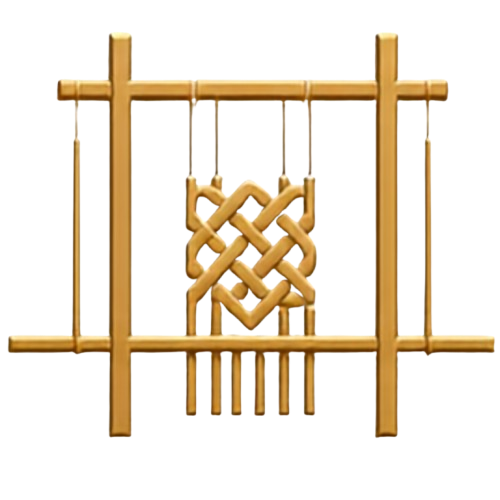
Two men sit cross-legged on a raised platform before a wooden frame that fills most of the room. This is the Kani loom. It looks, at first glance, like an impossible tangle — hundreds of small wooden bobbins hanging from the warp threads, each carrying a different colour of yarn.
Reading the Code
Kani weaving does not use a shuttle. Each colour is carried by its own small wooden bobbin — called a Kani — and the pattern is dictated by a handwritten manuscript called a Talim.
The Talim is a sequence of coded instructions. A reader calls out each line while the weaver translates it into thread placement: "three gold, two crimson, five ivory, one emerald." Row by row, the pattern builds. A complex design can require a Talim manuscript running to hundreds of pages.
There is no screen. No printout. No computerised guide. The system was developed centuries ago and it works today exactly as it did then.
The Pace of the Work
A Kani weaver completes roughly two centimetres of fabric per day. A full shawl can take anywhere from six months to over a year. The most intricate designs — with dozens of colour changes per centimetre — can take even longer.
During this time, the weaver cannot skip sections, cannot work out of order, and cannot undo a mistake without unweaving days of completed fabric. Every bobbin placement must be exact.
What You Cannot See
The remarkable thing about a finished Kani shawl is that none of this effort is visible. The front and back look equally clean. There are no knots, no loose threads, no visible joins between colours. The complexity of the process disappears entirely into the beauty of the result.
This is the hallmark of mastery in any craft: the difficulty becomes invisible.
Why It Matters to Us
We work directly with Kani weavers in Srinagar. When you order a Kani piece from us, we can tell you which workshop produced it. The price you pay reflects the actual time invested — months of skilled labour at a pace that no market pressure can accelerate.
There are fewer than a thousand people in the world who can do this work. Each piece is a document of their knowledge.


