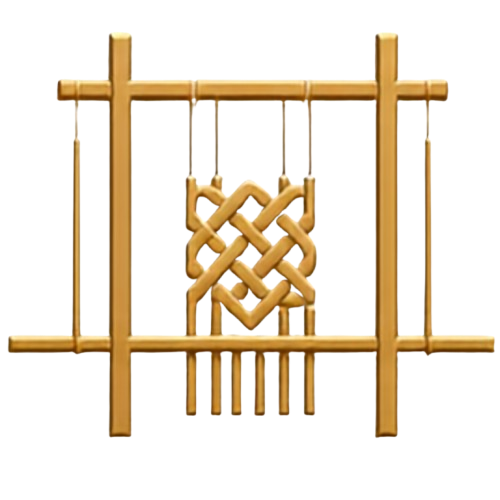
The Language of Wooden Bobbins
Among the many textile traditions of Kashmir, none combines artistry, mathematics, patience, and craftsmanship quite like Kani weaving. Every authentic Kani shawl represents thousands of deliberate decisions made by a master weaver, often over many months. It is not embroidered after weaving; its intricate designs are woven directly into the fabric, thread by thread.
To understand a Kani shawl is to appreciate one of the most sophisticated hand-weaving traditions ever developed.
What Does “Kani” Mean?
The word Kani refers to the small wooden bobbins used to insert coloured weft threads into the fabric. Traditionally carved from lightweight wood, each bobbin carries a single colour of yarn.
Unlike ordinary weaving, where a single shuttle carries the weft across the width of the fabric, Kani weaving may require dozens or even hundreds of bobbins working simultaneously.
Each bobbin introduces only the colour required for a particular section of the design. As a result, the pattern is created during weaving itself rather than added afterwards.
A Craft of Extraordinary Precision
At first glance, a Kani loom resembles an ordinary handloom. The difference lies in the complexity of the weaving.
Instead of repeating a simple sequence of warp and weft, the weaver constantly changes coloured yarns according to an intricate plan. Every motif, border, curve, and floral element must be built one small section at a time.
Unlike embroidery, where decoration is applied to an existing fabric, Kani weaving creates the design and the cloth simultaneously.
This integration of structure and decoration gives authentic Kani shawls their remarkable richness and durability.
Taleem – The Secret Language of the Loom
One of the most fascinating aspects of Kani weaving is the Taleem system.
A Taleem is a coded set of weaving instructions that translates an artist’s design into a sequence of coloured threads. Rather than reading a visual drawing directly, the weaver follows this written code, which tells them:
- Which colour to use.
- How many threads to weave.
- Where to change colours.
- When to repeat a sequence.
The Taleem acts as a bridge between the designer and the weaver. It allows extremely complex patterns to be reproduced with remarkable consistency while preserving the traditional workflow of specialised artisans.
Historically, learning to read Taleem required years of training, and the knowledge was often passed down within families or workshops.
A Collaborative Art
Creating a Kani shawl is rarely the work of one individual. It is the outcome of several specialised crafts working together.
The process begins with the Naqash, the designer who conceives the pattern. The design is then translated into Taleem by a skilled Taleem writer, who converts visual motifs into coded weaving instructions.
Only after this preparation does the work pass to the weaver. Following the Taleem line by line, the weaver uses multiple Kani bobbins to build the design directly into the cloth.
This collaboration between designer, Taleem writer, and weaver reflects the highly organised craft tradition that evolved in Kashmir over centuries.
Motifs Inspired by Nature
Traditional Kani designs are deeply rooted in the visual language of Kashmir.
Common motifs include:
- The Badam (almond), symbolising growth and renewal.
- The Chinar leaf, inspired by Kashmir’s iconic tree.
- Flowing floral vines and blossoms.
- Paisley forms, which evolved from earlier botanical motifs.
- Garden-inspired compositions reflecting Mughal aesthetics.
These patterns are not merely decorative. They express cultural memory, artistic traditions, and a close relationship with the natural landscape.
Time Beyond Measurement
Unlike industrial textiles, where production is measured in hours or days, authentic Kani weaving is measured in patience.
The time required depends on the complexity of the design, the number of colours, the fineness of the yarn, and the size of the shawl. Simpler pieces may take several months, while exceptionally intricate examples can require much longer.
Each day of work may add only a small portion to the overall design, yet every carefully woven section contributes to the finished masterpiece.
Preserving a Rare Tradition
Today, authentic Kani weaving faces significant challenges. Mechanised production, printed imitations, and changing market pressures have reduced the number of artisans practising this demanding craft.
Yet the tradition endures through the dedication of master weavers who continue to preserve techniques passed from one generation to the next. Their work represents not only technical excellence but also an important part of Kashmir’s cultural heritage.
Supporting authentic Kani weaving means supporting the communities, knowledge, and traditions that keep this extraordinary art alive.
Kani as Cultural Heritage
A genuine Kani shawl should not be viewed simply as a luxury accessory. It is the culmination of design, mathematics, craftsmanship, and history woven into a single textile.
Every bobbin movement, every coded instruction in the Taleem, and every motif carries forward a tradition that has survived for centuries. In this sense, a Kani shawl is more than an object—it is a woven archive of Kashmir’s artistic legacy.