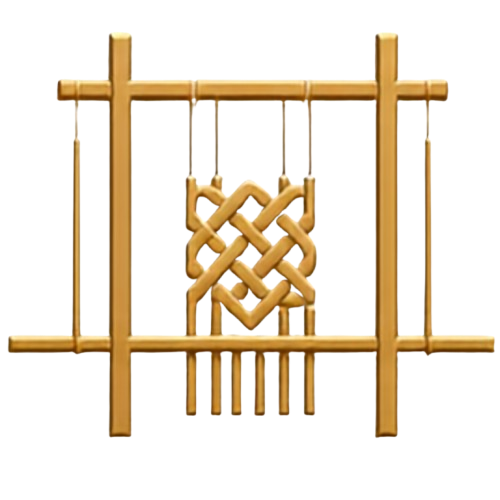
The Loom That Paints with Thread
Some textiles are woven.
Some are embroidered.
A Kani shawl is something entirely different.
It is not decorated after weaving.
The design is created as the fabric itself is woven, thread by thread, colour by colour.
Every motif is born directly on the loom.
To watch a master Kani weaver at work is to witness a painter whose brush has been replaced by hundreds of tiny wooden bobbins.
What Does “Kani” Mean?
The word Kani refers to the small wooden bobbins used during weaving.
Each bobbin carries a different coloured yarn.
Unlike an ordinary shuttle, which passes continuously across the width of the loom, these small Kanis are used individually to build intricate designs.
A single shawl may require dozens—or even hundreds—of Kanis working together.
Each one contributes only a small part of the final composition.
A Language Hidden in Numbers
One of the most remarkable features of Kani weaving is the Taleem system.
A Taleem is a written code that translates an artistic design into precise weaving instructions.
It does not resemble an ordinary drawing.
Instead, it tells the weaver:
- Which colour to use.
- Where it should appear.
- How many threads it should cover.
- When to change to the next colour.
The Taleem is the invisible bridge between imagination and fabric.
Without it, many of the most complex Kani masterpieces would be impossible to weave accurately.
Weaving Without Seeing the Whole
A fascinating aspect of Kani weaving is that the weaver often focuses on a small section of the design at any given moment.
The complete image emerges gradually over weeks and months.
Only with patience does the full composition reveal itself.
This process requires extraordinary concentration.
A single mistake can disturb the harmony of the entire design.
A Symphony of Colours
Unlike printed textiles, where colour is applied to the surface, a Kani shawl builds colour from within the weave itself.
Each coloured thread becomes part of the fabric’s structure.
This creates remarkable depth, subtle transitions, and a richness that changes gently with the light.
The colours are woven into the cloth—not laid upon it.
Time Beyond Measurement
People often ask:
“How long does it take to make a Kani shawl?”
There is no single answer.
The time depends on:
- The complexity of the design.
- The number of colours.
- The fineness of the yarn.
- The size of the shawl.
- The experience of the weaver.
Simple designs may take several months.
The most intricate museum-quality masterpieces can require many months or even more than a year of dedicated work.
Time is not an expense.
It is one of the ingredients.
When Two Weavers Become One
Many complex Kani shawls require two weavers working side by side at the same loom.
Their movements must remain perfectly coordinated.
One cannot rush ahead.
The other cannot fall behind.
Their work resembles a musical performance.
Success depends upon rhythm, trust, and shared understanding.
The shawl grows through cooperation.
Why Kani Cannot Be Rushed
Modern manufacturing values speed.
Kani weaving values precision.
Machines may imitate the appearance of traditional designs.
They cannot reproduce the countless decisions made by an experienced weaver during the creation of an authentic Kani shawl.
Every adjustment reflects judgment.
Every colour transition reflects artistic understanding.
The human hand remains irreplaceable.
The Great Masterpieces
Throughout history, the finest Kani shawls have represented the highest achievement of Kashmiri weaving.
Many historic examples display astonishing complexity.
Borders appear to flow effortlessly into central fields.
Floral compositions seem almost alive.
Hundreds of colours exist together in perfect harmony.
Such works demonstrate not merely technical skill but artistic vision.
A Living Tradition
Although Kani weaving faces modern challenges, master artisans continue to preserve this remarkable craft.
Every apprentice who learns the Taleem.
Every artisan who prepares the Kanis.
Every weaver who completes another masterpiece.
Each contributes to the survival of one of humanity’s greatest textile traditions.
The future of Kani weaving depends not only on those who create it, but also on those who recognise its value.
Closing Reflection
A Kani shawl is often admired for its beauty.
Yet beauty is only the visible result.
Hidden beneath every motif are countless hours of concentration, inherited knowledge, mathematical precision, and artistic imagination.
The finished shawl appears effortless.
Its creation is anything but.
Perhaps that is the greatest achievement of Kani weaving.
It transforms extraordinary complexity into effortless elegance.
“The finest Kani shawls do not merely display patterns. They preserve a language of colour, patience, and memory that has been spoken on Kashmiri looms for centuries.”